The law
When did these become legal here?
27 August 2026, across England, Scotland and Wales, under regulations made on 16 July that year. Until that morning nobody could lawfully sell you one, because the plug and socket standard would not carry a plug on generating equipment.
Will I need planning permission?
Usually not, although nothing here is automatic. These rely on the permitted development right for small scale solar, and the right comes with conditions. Satisfy them and no application happens. Miss one and an application does.
Where does a timber balcony leave me?
Outside the right, in England, where the balcony, its enclosure or the wall behind it is wooden, or where the outside of the building is clad in timber. A metal or glass balustrade on a masonry building lands somewhere else entirely. Scotland and Wales carry no such exclusion and say nothing about plug-in solar at all, so the planning authority is who to ask there.
Is the old rule still available?
In England, until 27 August 2027. Twelve months of transition run from the change, and inside that window either version of the rules is open to you.
My house is listed.
Then this becomes a planning conversation. Permission and listed building consent are both wanted, and the right vanishes in the grounds of a listed building or on a scheduled monument. Speak to the authority before ordering anything.
The kit
What size are these?
Think of four ceilings: 800 VA of apparent power reaching the mains, 3.5 amps, four panels on one inverter and 2000 watts of panel altogether. The supply runs at up to 253 volts and 50 hertz, and no string may carry more than two panels in series.
Eight hundred watts on the box, 800 VA in the rules.
Because they measure different things. The regulations define the device by a maximum rated alternating current output of 800 watts. The specification puts a ceiling of 800 VA on apparent power. Neither is wrong and neither is the other.
How can I tell a kit is approved?
Search the ENA Type Test Register for it. Nothing may be sold until its maker has had the type tested, entered it and been told it passed. Models that failed stay on the list marked non-compliant, which is what puts the register ahead of any seller table.
Can I add a battery?
No. Storage sits outside the approved class, whether it comes on its own or built into the device.
Can I have two?
One per home. The connection rules set that number and they are stricter than the product specification.
How much it makes, and what changes that
How much would I get in a year?
Somewhere between about 628 and 897 kilowatt hours from a single 800 watt device on an unshaded south facing pitch, depending where in Great Britain you are. Brighton sits at the top of that range and Inverness at the bottom. They are modelled at one point per region, so read them as a ceiling.
Does the part of the country matter most?
No. Top of the table to bottom is about 43 per cent on an ideal pitch. At one address, moving from a pitch to an upright east facing wall costs about half the output. What it is fixed to outweighs where it is.
Will it take that much off the bill?
No. Your saving depends on what you are running while the panel is working, and with storage outside the approved class the rest goes back to the network rather than into a battery.
What about shade?
Every number here is drawn as though nothing stands between panel and sky. A tree, a chimney, a dormer, the house across the road: each takes a bite, and a model cannot see any of them. Somebody has to stand in the spot and look up.
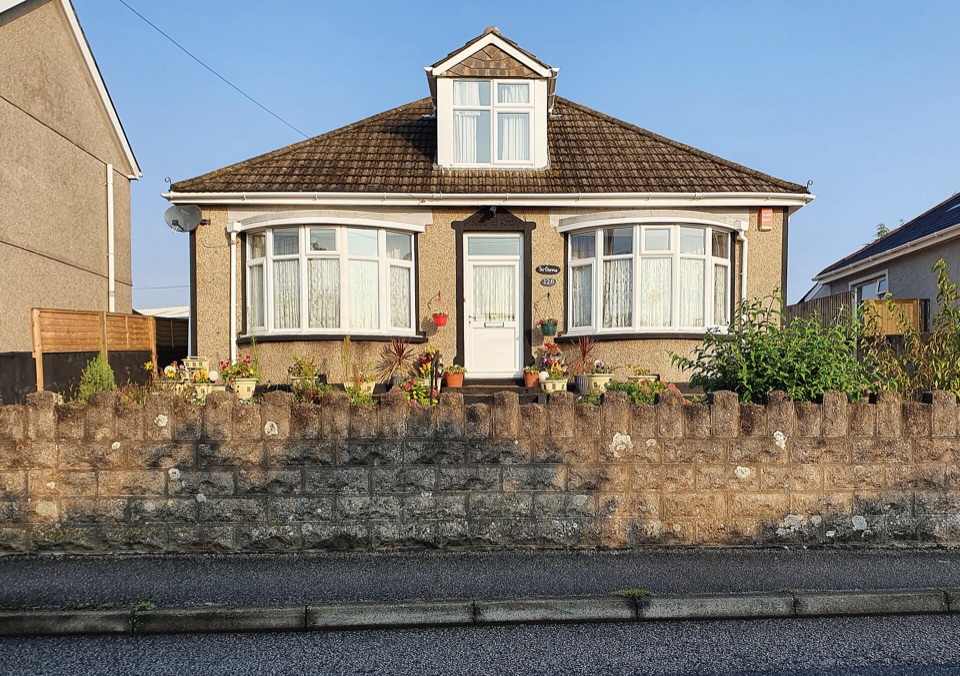
A bungalow in Camborne, Cornwall. A low hipped roof, a front wall and a garden give three different answers at one address.
Generation modelled in PVGIS at 0.8 kWp with 14 per cent system losses, four mountings at one point per region, queried 13 September 2026. Everything the device may do comes from the interim product specification, version 2.0 of July 2026.
Money, renting and insurance
You have not put a price anywhere.
Because we have none we would defend. Kit prices move about and socket work differs in every house. Better to look at yours and give you a figure that means something.
We rent, or we hold a leasehold.
Then you need the landlord or the freeholder to agree. Consent, lease restrictions and building management all appear in the government response as things that may hold take-up back, and the regulations solved none of them for you. Ask before you buy.
Does it change my house insurance?
It might. A compliant device has to arrive with instructions telling you to ask. Ring the insurer before the box does.
This place was last rewired a very long time ago.
Then get somebody qualified to look at the socket and the circuit before anything goes into it. Old wiring is what consultation responses returned to again and again.
Do you take commission from a manufacturer?
No. You pay us and nobody else pays us, and the electrician pricing the socket bills you directly.
Not sure it's allowed at yours?
Postcode and where you'd put it. We'll check the rules for you.
- England
- Scotland
- Wales
Start with your postcode
Name, email, postcode, and where you'd put the panel. We reply with whether the rules cover that spot, what it would generate there, and what happens next.
We reply by email. Nothing is sold on and no manufacturer pays us.